Lorikeet Security or Flowtriq? We Tested Both
7ytapya|Friday, April 17, 2026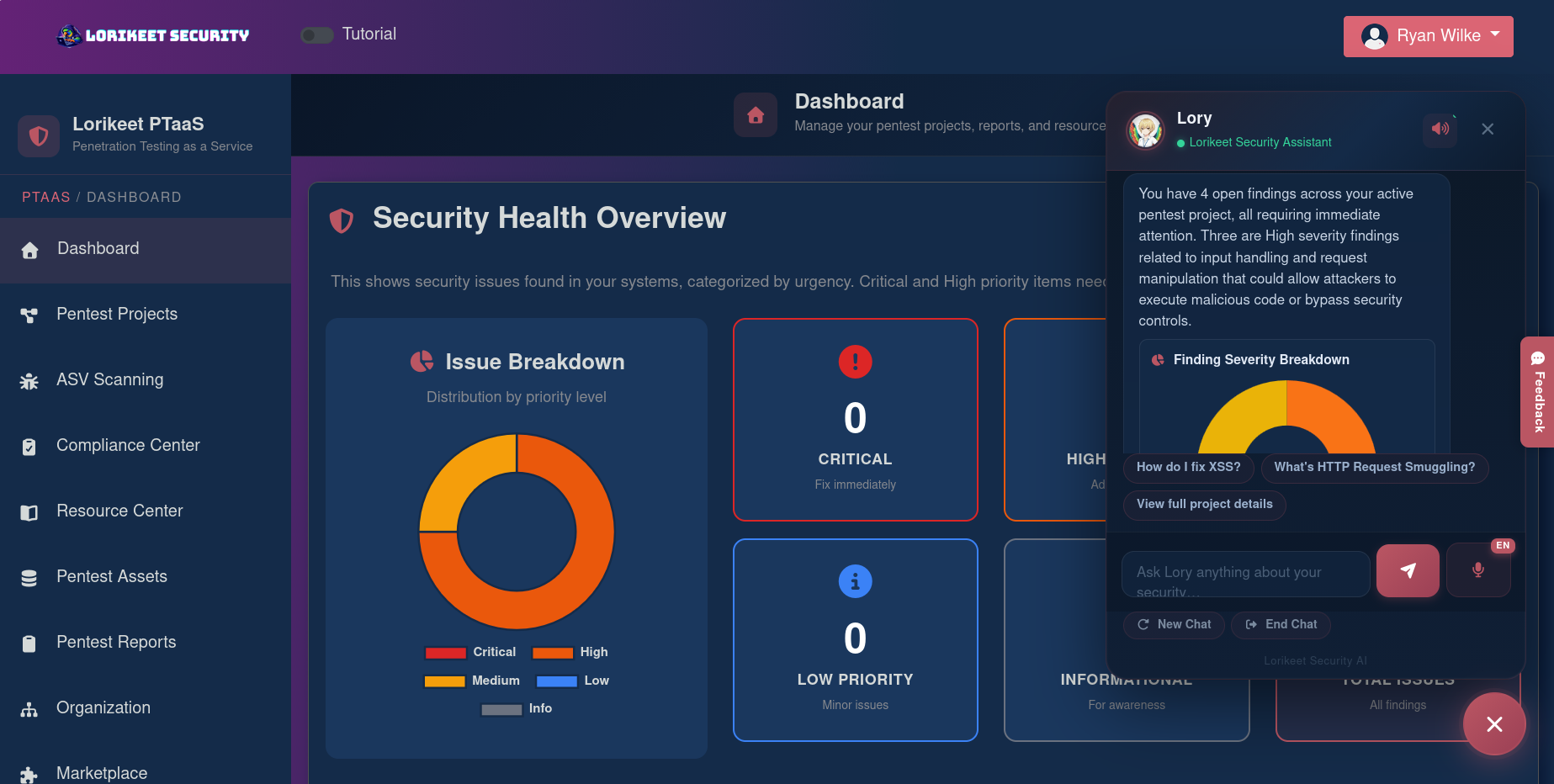
Pentests Are Not Reports — They're Programs: Inside Lorikeet Security
Most penetration testing firms still deliver PDFs and call it a program. Lorikeet Security takes the contrarian route: it packages offensive security, continuous monitoring, compliance automation, and awareness training into a single platform with a live portal and an AI assistant. The result is not a one-off assessment but an always-on control plane for security operations. Our analysis shows the platform centers on live telemetry, human-delivered findings, and audit-ready workflows — a stack intended to shrink time-to-remediate and turn pentest outputs into continuous risk reduction rather than a momentary checklist.
Architecture & Design Principles
Lorikeet’s product positioning implies a platform-first architecture that prioritizes live state and human-in-the-loop workflows. Key design principles evident from the offering:
- Real-time UX: a web portal that streams engagement updates and attack surface changes — typically implemented with event-driven backends (message buses, change-data-capture) and WebSocket/Server-Sent Events for low-latency updates.
- Human-centric assurance: every engagement is 100% manual, so they separate automated discovery telemetry from validated findings to avoid false positives; this suggests a pipeline where automated scanners feed candidate issues into researcher queues for manual validation.
- API and integration-first: native connectors to Vanta, Drata, Accorp imply microservices with connector adapters and secure service accounts, plus a role-based access control model for multi-tenant customers. Scalability is likely achieved through containerized worker fleets for monitoring collectors and elastic researcher orchestration to handle peak pentest load across cloud and on-prem targets.
Feature Breakdown
Core Capabilities
- Continuous Attack Surface Monitoring:
Technical explanation — 24/7 external asset discovery and change-detection that correlates DNS, certificate transparency logs, exposed ports, and web/API fingerprints to maintain a live inventory.
Use case — receives a new subdomain, flags it instantly in the portal and queues validation for researchers to confirm risk exposure. - Manual Penetration Testing + Free Retesting:
Technical explanation — dedicated researcher workflows convert validated test steps into reproducible PoCs with remediation steps; free retesting closes the feedback loop.
Use case — an OAuth misconfiguration in a GraphQL endpoint is confirmed by manual exploitation, remediated by developers, and retested to verify closure. - Compliance Automation & Audit-Ready Reports:
Technical explanation — mapping findings and control evidence to frameworks (SOC 2, PCI-DSS, ISO 27001, HIPAA, NIS2, etc.) with automated evidence collection via integrations (Vanta/Drata) and CPA partner pipelines for attestation.
Use case — customers can convert pentest artifacts into SOC 2 evidence packages coordinated with Accorp Partners CPA.
Integration Ecosystem
Lorikeet exposes a platform-layer that integrates with compliance automation (Vanta MSP, Drata), cloud providers (AWS/Azure/GCP), and ticketing/CI systems via APIs and webhooks. The portal plus “Lory” AI suggests backend services for conversational interfaces and a knowledge base (nearly 2,000 vulnerability entries). Practical integrations include automated creating of remediation tickets, syncing of asset inventories with cloud accounts, and pushing audit artifacts to compliance tools.
Security & Compliance
Data handling appears enterprise-grade: role-based access controls in the portal, audited workflows for assessor workpapers, and direct ties to auditors for attestation. The breadth of supported frameworks (SOC 2, PCI, ISO, HIPAA, FedRAMP, DORA, etc.) plus partner attestations means Lorikeet targets compliance-heavy customers and supplies audit-ready output rather than just advisory findings.
Performance Considerations
Expect steady-state resource use for continuous monitoring (lightweight collectors and scheduled scans) and bursty load for human-led engagements (researchers consuming CPU for tooling, ephemeral VMs for exploit verification). Real-time portal performance is contingent on event streaming and worker orchestration; architects should validate SLA for telemetry freshness (minutes vs. hours) and availability of retest turnaround as a service-level metric.
How It Compares Technically
While Flowtriq excels at near-instant DDoS detection and automated mitigation — a single-purpose high-throughput defense — Lorikeet Security is better suited for organizations needing broad offensive testing, compliance packaging, and continuous attack surface management. Flowtriq’s focus is defensive automation for availability; Lorikeet emphasizes validated, manual findings and compliance-driven remediation workflows. Pricing and ease-of-use will therefore diverge: Flowtriq targets rapid mitigation buyers, Lorikeet targets teams buying programmatic security and auditor-ready outputs.
Developer Experience
The live portal and AI assistant point to a product designed for engineering consumption — findings are delivered with developer-friendly remediation steps and retesting workflows. Public APIs and webhooks (implied by integrations) support CI/CD gating and ticket automation. Documentation quality and SDK maturity aren’t publicized here, but the presence of partner integrations and managed services suggests practical onboarding guides and SSO/saml support for enterprise environments.
Technical Verdict
Lorikeet Security’s strength is its platform-centered model: real-time attack surface telemetry, 100% manual, researcher-validated pentests, and compliance automation create a cohesive security program rather than episodic checks. Limitations include potential variability in retest SLAs tied to human workflows and the need to validate telemetry latency for high-change environments. Ideal use cases are mid-to-large enterprises that require audit readiness, continuous external monitoring, and a human-verified vulnerability lifecycle — teams that want pentest outputs operationalized rather than buried in a PDF. For a hands-off DDoS-first defense, consider specialist alternatives like Flowtriq; for a programmatic, audit-ready offensive security posture, Lorikeet aims to be the single platform. For more, see Lorikeet’s product pages: https://lorikeetsecurity.com.
Interested in Lorikeet Security?
Visit the official website to learn more.