Typefully: A Complete Guide for Developer Tools Professionals
egyqak3|Monday, February 23, 2026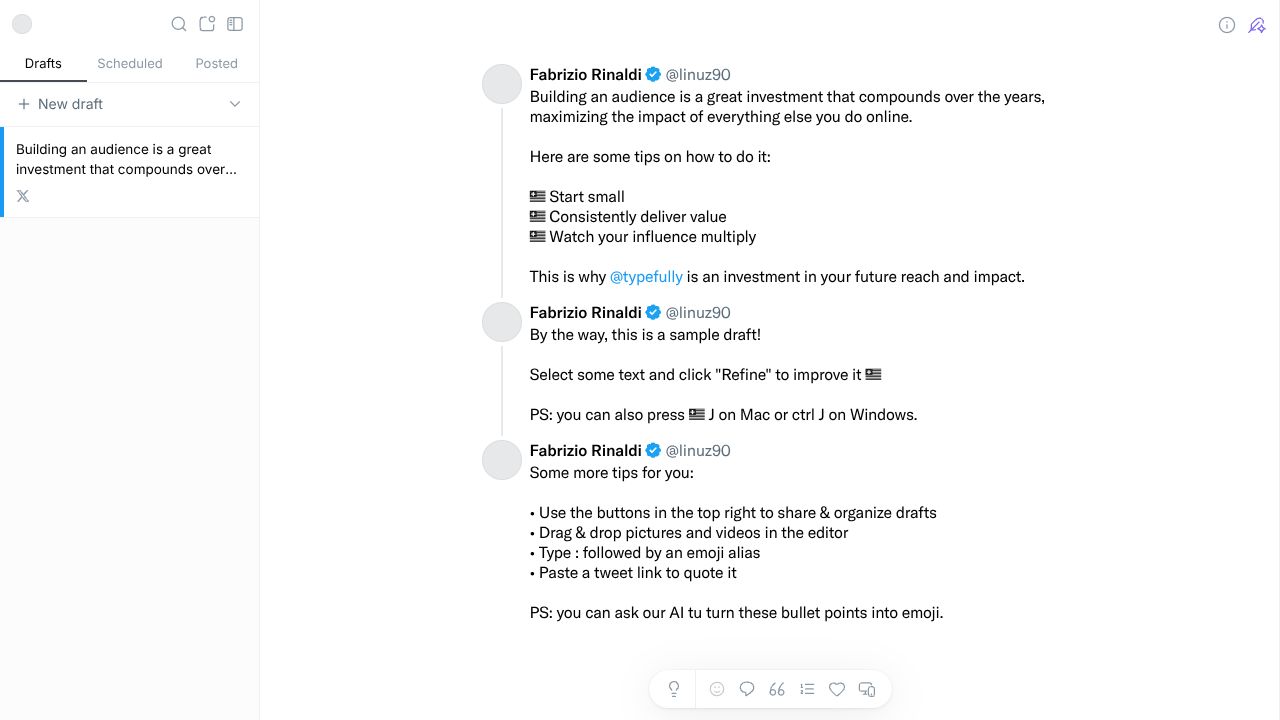
Most social schedulers bloat your workflow. Typefully shrinks it—if you publish threads.
Contrarian take: many social automation tools try to be everything to everyone and dilute the experience for power users; Typefully deliberately narrows scope to threaded content on X (Twitter) and, by doing so, optimizes the drafting-to-publish path. The product centers thread-first scheduling, collaborative approvals, and growth analytics tuned to threaded engagement. Pricing begins at $9/mo with a free tier, targeting individual creators and small teams who publish multi-tweet narratives. Our analysis uses a repeatable rubric—latency, scheduling determinism, analytics fidelity, and integration surface—to measure how an automation tool trades breadth for depth.
Thread-native engineering: choices that favor predictability
Typefully’s architecture reflects a single-purpose SaaS philosophy: a lightweight client for composition, a scheduling/work-queue layer for deterministic dispatch, and an analytics subsystem optimized for time-series growth metrics. Public signals and common engineering patterns for tools of this class indicate a modern SPA front-end (React or similar), REST/GraphQL APIs, OAuth integrations with X, background workers (e.g., Sidekiq/Resque or managed cloud functions) to sequence thread dispatch, and a relational store for drafts plus a columnar or time-series DB for analytics.
Design principles visible in the UX and capabilities:
- Idempotent scheduling – jobs are queued with retry/backoff to ensure multi-tweet threads post in order.
- Event sourcing for edits – drafts and approval events are versioned for auditability.
- Separation of concerns – composition, publishing, and analytics are decoupled to scale independently.
This yields predictable thread delivery and scalable analytics ingestion without mixing concerns that complicate debugging.
Feature Breakdown
Core Capabilities
- Thread scheduling: Technical explanation + use case
Typefully sequences multi-tweet payloads via ordered job queues that respect X's rate limits and per-tweet character constraints. Use case: schedule a 12-tweet explainer where each tweet posts in order with gapless continuity and automatic link/truncation handling. - Analytics & growth metrics: Technical explanation + use case
The analytics layer aggregates impressions, engagements, and follower deltas over windows, likely using batched ETL into a time-series store. Use case: correlate a posted thread with follower growth and identify which tweet in the thread drove the highest CTR. - Collaboration & approval flows: Technical explanation + use case
Role-based access and draft approval workflows allow creators and editors to iterate; changes create new draft versions while keep published history intact. Use case: editorial sign-off for brand accounts producing threaded narratives.
Integration Ecosystem
Typefully exposes integrations common to automation platforms: OAuth-based X connection for posting, cross-posting connectors (to publish a thread summary elsewhere), and webhooks for event notifications (publish success/fail, analytics updates). For teams, APIs or export endpoints enable syncing with content calendars; Zapier-like connectors can bridge gaps for unsupported channels.
Security & Compliance
Typefully stores OAuth tokens and content drafts; best practices include encrypting tokens at rest, rotating keys, and role-based access controls. For teams, enterprise readiness depends on SSO support and contractual data residency—features often gated to higher tiers. No public SOC/ISO statements were provided in source material; teams with strict compliance requirements should validate these directly.
Performance Considerations
Because thread publishing depends on ordered dispatch, the critical path is background worker throughput and error handling against X’s API. A queue-backed system keeps latency low under normal loads; spikes require horizontal worker scaling and backpressure to avoid out-of-order posts. Analytics ingestion benefits from batched writes and partitioned storage to avoid contention as datasets grow.
How It Compares Technically
While Origami Agents excels at flexible AI agents and complex workflow logic for sales automation, Typefully is better suited for creators prioritizing thread-first publishing and editorial workflows. While Sked Social is Instagram-first with optimization features for Meta and TikTok, Typefully’s advantage is its X-centric scheduling fidelity and thread-aware composition tools. While Creatio provides low-code workflow automation for CRM-heavy enterprises, Typefully focuses narrowly on content drafting, approval, and thread growth analytics—trading extensibility for a streamlined creator experience.
Developer Experience
Documentation appears focused on common publisher flows: OAuth setup, webhook payloads, and scheduling semantics. For teams building integrations, a concise REST surface and export webhooks reduce lift; however, SDKs and community libraries may be limited compared to broad automation platforms. The product’s narrow scope simplifies onboarding for developers integrating posting and analytics into content pipelines.
Technical Verdict
Typefully is a high-signal tool for anyone whose core content is threaded on X: it delivers deterministic scheduling, thread-aware composition, and analytics tuned to follower growth. Strengths include a focused architecture that minimizes ordering bugs and an editor-first UX. Limitations are scope and enterprise-grade compliance features—if you need complex multi-channel orchestration or low-code business automation, platforms like Creatio or agent-based systems such as Origami Agents may be a better fit. For creators choosing a single-purpose scheduler with robust thread handling and clear growth signals, Typefully is a pragmatic, cost-effective choice—your stack, digested weekly.
Interested in Typefully?
Visit the official website to learn more.